Americans want tariffs lifted from allies like Australia — for now
Americans want tariffs lifted from allies like Australia — for now
Sixty percent of Americans want tariffs lifted from close allies like Australia — virtually unchanged since April — but enthusiasm is cooling and the President’s own base is warming to tariffs as a ‘necessary’ evil, just as a new U.S. trade action threatens Australia with new 12.5 percent tariffs.
American demand for tariff relief on close allies like Australia has held firm in the months of April and May — but the latest Bondi Partners U.S. Pulse poll shows the political tailwind behind it beginning to thin.
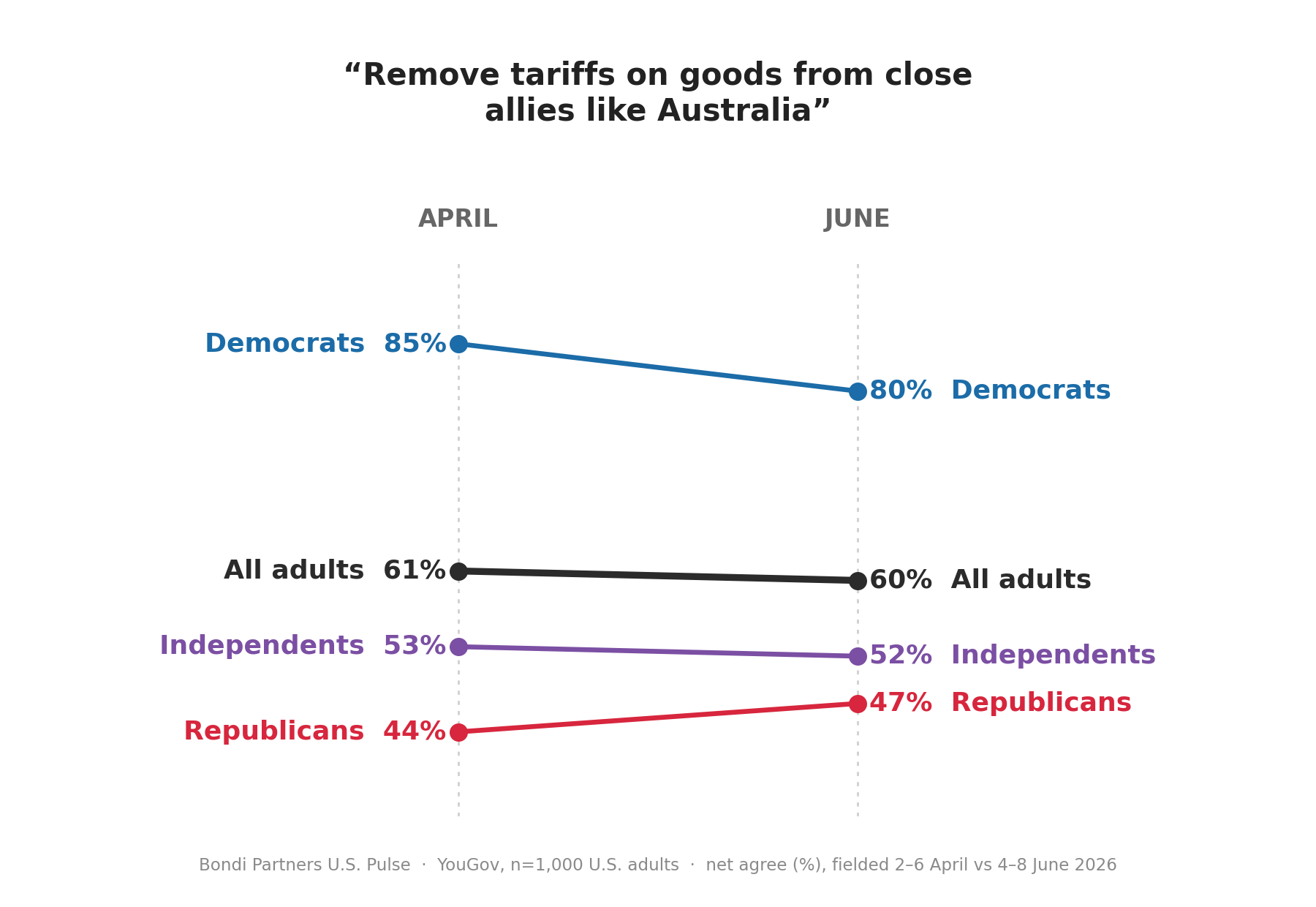
Sixty percent of Americans agree the United States should remove tariffs on goods from close allies like Australia, against just 13 percent opposed — a margin of more than four to one.
It remains the single most popular tariff-relief position tested, backed by majorities of Democrats and Independents and nearly half of Republicans.
But beneath that stable headline, two things are shifting
The intensity behind allied relief is fading — strong agreement that allied tariffs should be removed fell six points, from 41 to 35 percent.
And the rival argument, that tariffs are a ‘necessary’ evil, is gaining ground inside the Republican base, even as most Americans still reject it.
The Bondi Partners U.S. Pulse — a nationally representative poll delivered by YouGov — re-ran three tariff statements first fielded in April, word for word, allowing a direct trend across the nine weeks to early June:
- “The government should pause tariffs on imported everyday goods to help bring down prices for American consumers.”
- “The government should remove tariffs on goods from close allies like Australia to help bring down prices for American consumers.”
- “Tariffs on imported goods are necessary to protect American jobs and industries, even if they increase prices for consumers.”
Tariffs and allied trade — the headline finding
Relief for allies remains the most popular option
Removing tariffs on goods from close allies like Australia is the most popular of the three positions tested.
Sixty percent of Americans agree and only 13 percent disagree — a margin of more than four to one — statistically unchanged from 61 percent in April.
Support is broad: 80 percent of Democrats, 52 percent of Independents, and 47 percent of Republicans, nearly half the President’s own party.
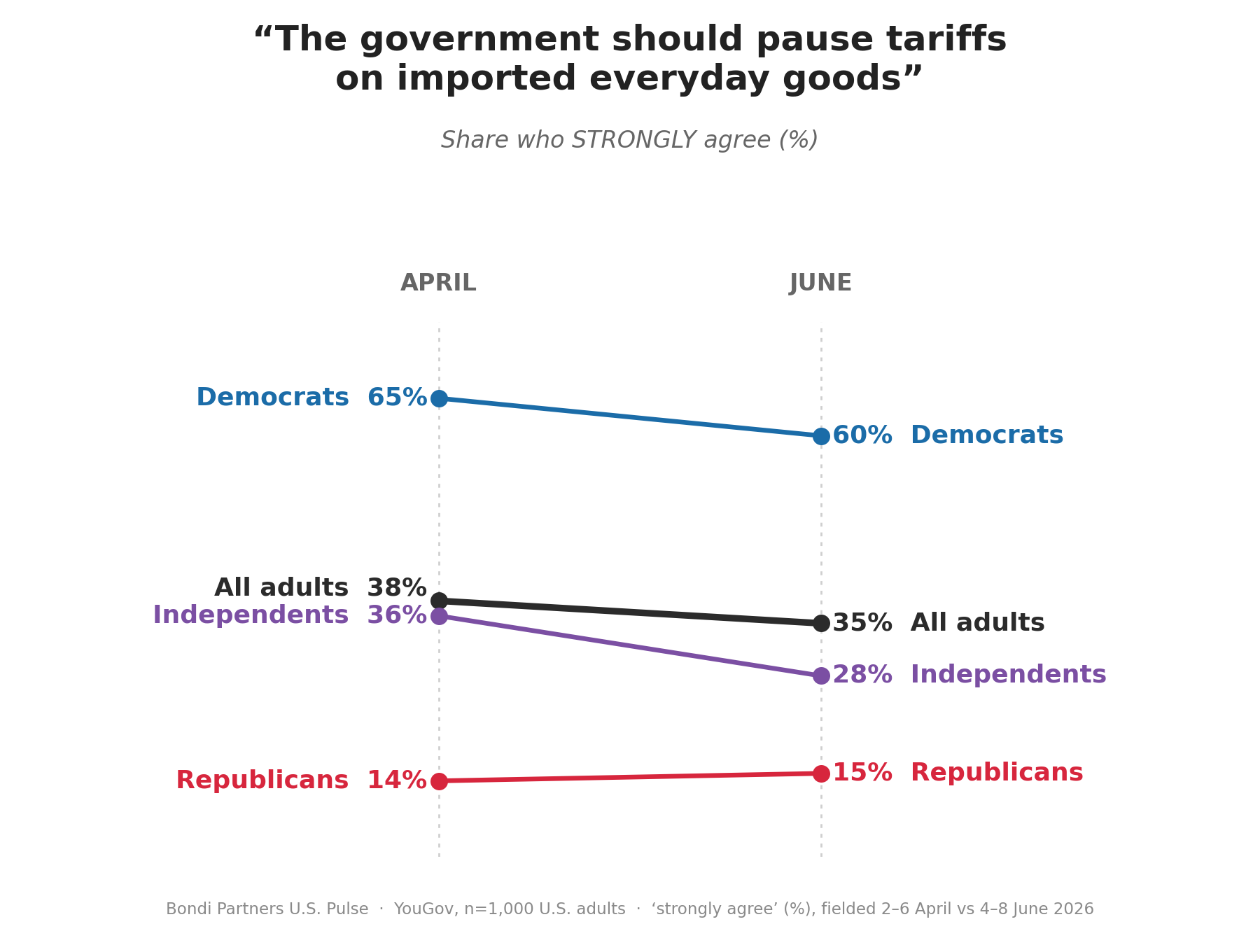
A general pause on everyday-goods tariffs draws the same 60 percent support. The appetite for relief that emerged during the Iran energy shock has neither grown nor faded at the headline level.
But the conviction is fading
Perhaps the most surprising result is that even as cost of living pressures increased over the nine weeks between the two polls, the intensity of support for tariff relief decreased.
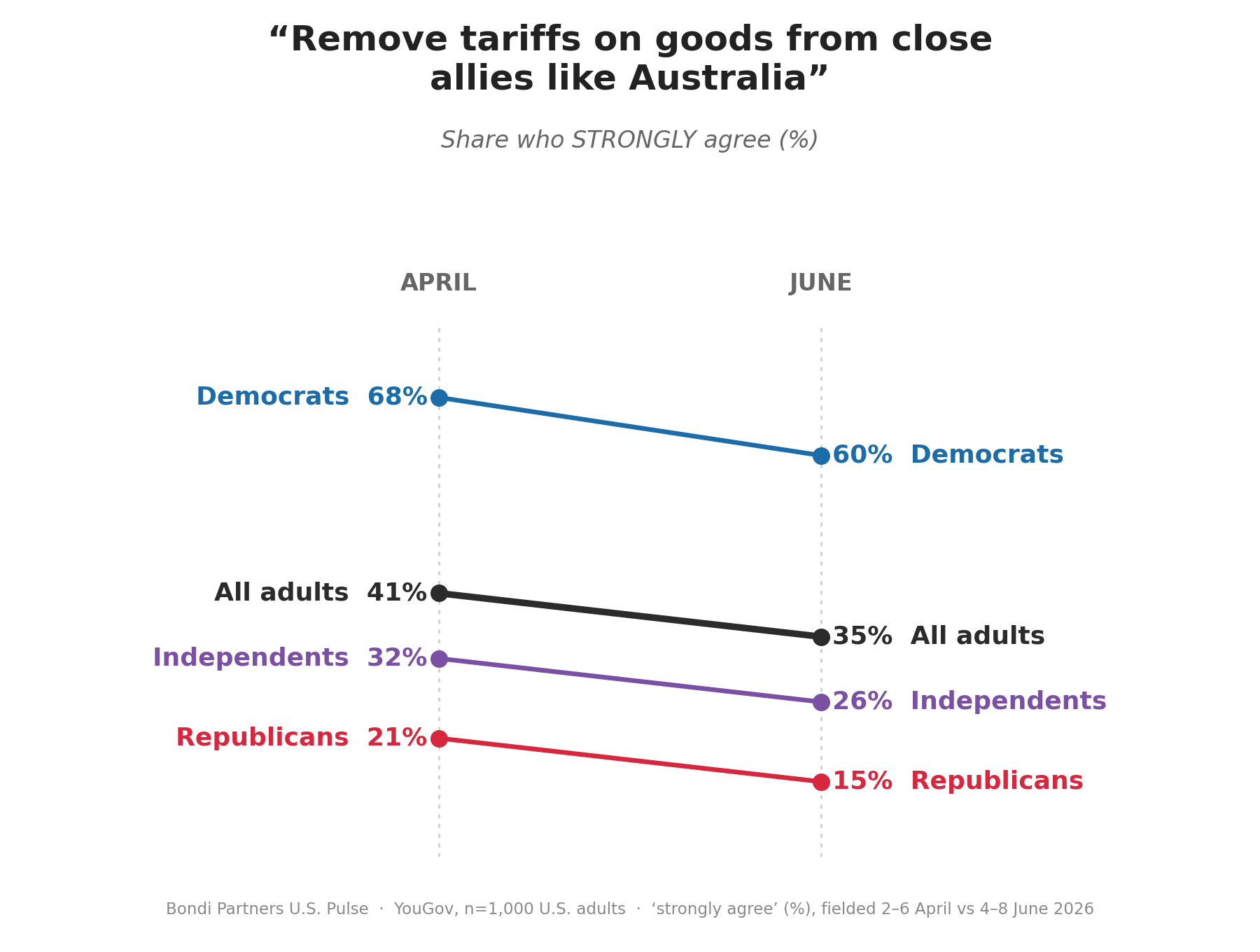
Strong agreement that allied tariffs should be removed fell from 41 to 35 percent — a statistically significant drop — with decreases shown across all parties.
Strong support among Democrats fell eight points, and strong support from both Independents and Republicans fell by six points.
The same softening shows on a general pause.
Americans still want tariff relief, they simply want it less emphatically than they did in early April.
The ‘necessary’ case is rising — and it is a Republican story
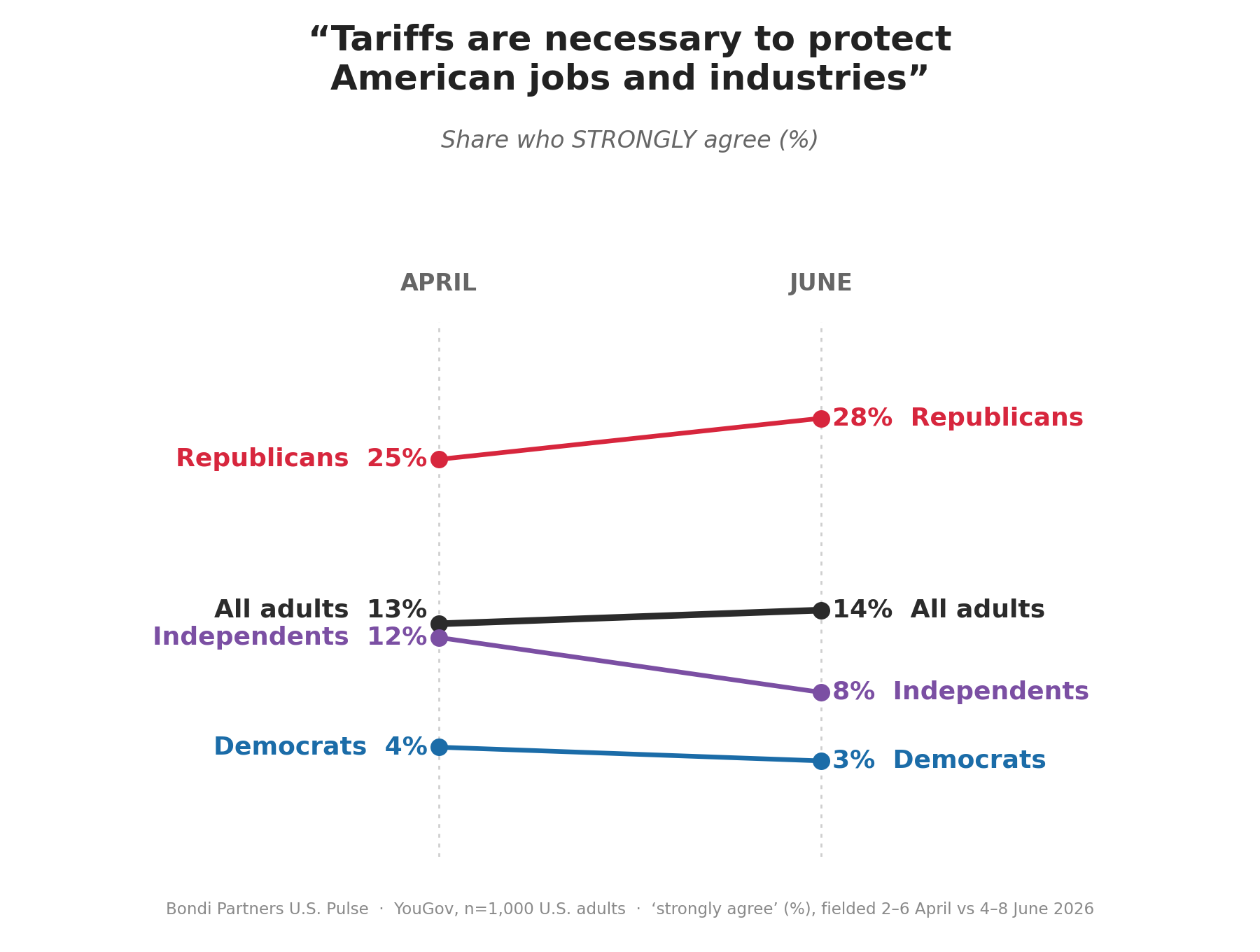
The sharpest movement is on whether tariffs are ‘necessary’ to protect American jobs.
Across all adults, agreement rose from 33 to 36 percent and net opposition narrowed from six points to two — directionally toward acceptance, but within the poll’s margin of error.
The decisive shift is partisan. Among Republicans, agreement that tariffs are necessary climbed from 59 to 68 percent, a statistically significant jump, and hard opposition halved, with strong disagreement falling from 7 to 3 percent.
Independents moved the other way, from 28 to 24 percent, and Democrats stayed firmly opposed, with only 14 percent agreement.
The ‘necessary evil’ case is not yet a national majority — 38 percent of Americans still reject it — but it is consolidating inside the President’s own coalition.
What this means for Australia
For Australia’s negotiators, the headline is: a clear American majority, including nearly half of Republicans, wants tariffs lifted from close allies like Australia.
It is the most popular relief position in the survey and the cleanest cross-partisan signal an ally could carry into Washington.
But the data also carries a deadline. The intensity behind allied relief is easing, and the competing ‘necessary’ argument is hardening among Republicans — the very base whose support any relief for Australia would ultimately need.
The case that American voters — Republicans included — want relief for allies is strongest now, not later.
Commentary
Quotes attributable to Joe Hockey, President and Founding Partner, Bondi Partners:
“Two months on, the message from American voters hasn’t changed: a clear majority, including nearly half of Republicans, wants tariffs lifted from allies like Australia. That remains the strongest card Australia’s negotiators can play in Washington.”
“But the window is narrowing. The intensity behind tariff relief is fading, and the President’s own base is starting to accept tariffs as a necessary evil. The political ground is still favourable for Australia — but this is the moment to press the case, not to bank it.”
Quotes attributable to Chelsey Martin, CEO of Bondi Partners and former Australian diplomat:
“I’ve sat across the table in trade negotiations with the United States for many years. Public opinion is never the whole story, but it shapes what is politically possible — and right now it is on Australia’s side.”
“With a proposed new tariff action placing Australia in the higher tier and the comment period closing in July, this data lands at exactly the right moment. As we move toward the midterms, an American public that wants relief for allies is a card Australia’s negotiators should be playing now.”
Context
The June wave was fielded as Washington opened a new front in the tariff fight.
On 2 June 2026, the Office of the United States Trade Representative proposed additional tariffs of 10 to 12.5 percent on 60 economies — together almost the entire U.S. import base — under a Section 301 forced-labor investigation, replacing tariffs struck down by the Supreme Court in February.
Australia was placed in the higher 12.5 percent tier, alongside Japan, South Korea, China and India. The European Union, United Kingdom, Canada and Mexico were set at 10 percent.
The action is not a finding that Australian goods involve forced labor; the complaint is that Australia does not ban the import of forced-labor goods.
Canberra has called it unjustified and inconsistent with the Australia–U.S. Free Trade Agreement. The tariffs are proposed, not yet in force: written comments are due 6 July, hearings begin 7 July, and a final determination is expected around the 24 July expiry of the current tariffs.
The tiering rewards bilateral trade-deal commitments with the lower 10 percent rate, which is a path Australia could yet negotiate.
While other allies like the European Union, Japan, South Korea, Switzerland and the United Kingdom, have all negotiated bilateral tariff-relief agreements with the United States, Australia has not.
Greer’s public position has been blunt, telling the Australian Superannuation Investment Summit: “If your point is ‘take down all the tariffs’, we’re not going to get along.”
About the Bondi Partners U.S. Pulse
The Bondi Partners U.S. Pulse is a monthly polling series measuring American attitudes on issues of public policy that have direct implications for Australia and its relationship with the United States. It is the only poll that regularly tracks American attitudes to the issues that impact the Australia–U.S. relationship.
The U.S. Pulse is commissioned by Bondi Partners, the strategic advisory firm founded by former Australian Treasurer and Ambassador to the United States, Joe Hockey, who served as ambassador during the first Trump presidency.
Methodology
The Bondi Partners U.S. Pulse is conducted by YouGov. This wave surveyed 1,000 U.S. adults using YouGov’s online panel and was weighted to be nationally representative of the U.S. adult population by age, gender, race, education, and 2024 presidential vote. The overall margin of error is ±3.9 percentage points at the 95 percent confidence level.
Fieldwork was conducted from 4 to 8 June 2026. Trend comparisons are to Wave 2, fielded 2 to 6 April 2026 (±3.5 percentage points); the three tariff statements were fielded with identical wording in both waves.
Movements described as statistically significant are significant at the 95 percent confidence level after adjustment for the survey design effect; party groups use leaned party identification.
More insights like this.
Americans agree AI data centers are a problem — but nobody agrees on the solution
Americans agree AI data centers are a problem — but nobody agrees on the solution Two in three Americans say…
Trump’s tariffs are mobilizing midterm voters – against candidates who back them
Trump’s tariffs are mobilizing midterm voters – against candidates who back them More than four in ten Americans say the…